



Introduction
The announcement of the establishment of the Ansar al-Sharia group in Tunisia in April 2011 by Seif Allah Ben Hassine54 was no accident. Rather, it was the crowning of the journey of a group of Tunisians who, in the late 1980s and early 1990s, migrated to different European countries including northern Italy, with many of them settling in Milan.
The1990s, more specifically the early months of 1994, proved to be a turning point for these Tunisian migrants. They regularly visited the Milan Islamic Cultural Center and the Omar El Farouk Mosque in the city of Varese where they were recruited and later on became the building blocks of the Milan cell. From that moment on, and in a parallel move, some of the group members joined other Islamic centers in several European countries including Spain, England (London), Belgium, France, Germany and Switzerland, and in some Arab countries, in particular Algeria and Sudan. Jean Louis Bruguière, the French anti-terrorism judge, pointed out the links between the Milan Cell and the Brussels Cell led by Tarek Maaroufi55,a Tunisian national.
When the Milan Cell was set up, the Tunisian members of the cell had only one goal in mind: reviving Islam and spreading the word of Allah and the precepts of Sharia everywhere in the world. They joined training camps in Afghanistan and fought along side Muslims in Bosnia and Algeria. They wanted to gain experience before launching the fight in Tunisia in July 2001. However, at that very time, the Milan Cell and its members were unmasked and arrested, while others stoodtrial before the Permanent Military Court in
54 Confidential investigation report N°08/2 of 21 August 2001 by the State Security Administration regarding case No. 1895. The report was commissioned by the investigating judge number 3 at the Permanent Military Court of Tunis pursuant to Order n°1008/3 of 9/8/2001. The report indicates that Seif Allah Ben Hassine, alias Abu Yadh, had contact with the Milan group, in particular with Sami Essid and Youssef ElAidaoui.
55Investigation report No. 12/2001a/s of the French Ministry of the Interior dated June 20, 2001 in relation to the rogatory commission of 6/2/2001 n°1395 issued by the investigating judge Jean Louis Bruguière
Tunis. In 2006, aterrorist attack was carried out in Soliman (in the Governorate of Nabeul) bya group of jihadists led by Lassaad Sassi56. Starting from July 2013, this terrorist leader received training in the ranks of the group called “Bakoun ala Ahd” in the Algerian mountains together with Zouheir Riani, another member of the Milan Cell57. Later on, Riani joined the ranks of Ansar al-Sharia,a group that was classified by the Tunisian government a terrorist organization on July 27, 2013.
Let us go back to the Milan Cell starting with its creation(I) all the way through to its gradual disappearance and then its merger with Ansar al-Sharia (II)
I. Setting up the Milan Cell
The data regarding the recruitment of the members of the Milan Islamic Center(1) and the fight they waged in the name of Islam as well as the role played by each of these members(2) are all gathered from the case files examined by the Tunisian courts.
1. Recruitment
Irregular migration to Italy, the level of educational achievement of each member of the Cell, affiliation with an extremist ideology, and participation in jihadist training camps and in terrorist operations were all key elements common to all Milan Cell members, ultimately leading up to the establishment of the Milan Cell.
· Irregular migration to Italy
Italy has long been a country of destination for the disadvantaged young Tunisian school drop-outs who are unemployed or who have in secure jobs. This was the case of the Milan Cell members who migrated in search of a better life: Adel Saidi58 , Mohamed Aouadi59 , Mokhtar Bouchoucha, Sami Essid, Moncef Hammami60, Mehdi Kamoun,
56 Emir of the Soliman group called “the soldiers of Assad Ibn Fourat” and member of the Milan Cell. He died during the attack. See ruling N°. 9200 handed down by the criminal chamber of the Tunis Court of Appeals on June 12, 2007. 57 Ruling No. 11597 dated 7/10/2008 of the criminal chamber of the Tunis Court of Appeals, handed down in the Soliman case.
58 During his interrogation on March 29, 2004, he declared that he was in Milan in 2001 where he attended lessons on jihadat the Islamic Cultural Center. He had no knowledge of jihad or terrorist movements at the time he migrated illegally to Italy in 1998. See Judgment No. 8463/2004 handed down by the Criminal Chamber of Tunis Court of First Instance on 15/2/2005.
59 Mohamed Aouadi declared that he illegally crossed the borders to Italy from the city of Sfax. He settled in Milan where he was a drug trafficker for a year and a half. Subsequently, he turned into adevout Muslim after he started to attend the Islamic Cultural Center. End of Investigation Order n°28156a issued by Investigating Judge n°1 of office 12 of the Anti-Terrorism Judicial Pole.
60 Moncef Hammami was arrested by the Tunisian authorities at Tunis-Carthage airport on his way back from Pakistan after having been detained there for three years on charges of fighting alongside terrorist groups in Afghanistan where he had traveled from Milan, the city where he had lived permanently since 1996. Judgment of the Indictments Chamber No. 67676/9, Tunis Court of Appeals,14/11/2004.
Moez Fezzani61, Walid El Mejri, Mohamed haouachi, Imed Jamelli, Ali Toumi, Bashir Ben Zayed and others.
· Primary school drop-outs with insecure jobs
The interrogations of the members of the Cell revealed that all of them had insecure jobs before they migrated to Italy. Indeed, many were day laborers. Others occasionally did some carpentry (ImedJamelli62) or construction work (Bashir Ben Zayed),were market vendors (for example, Sami Essid sold shoes,) or were simply unemployed.
Most of them were primary or secondary school drop-outs. They declared having discovered Al-Aqidat Al-Wasittiyah, Ibn Taymiya’s book and the work of Abdul Kader Bin Abdoul Aziz, “Umda fi I’dad al-‘Udda”, both indispensible for the preparation of Jihad.
· Affiliation with extremist thinking
Recruiting these little educated exiles who were living in precarious conditions was not a huge deal. They all got to know each other at the Milan Islamic Cultural Center or at the Varese Mosque where they made their first steps into their new world: lectures, video tape projections of fighting groups in Bosnia with emphasis on Tunisian fighters who stood out from the rest.
It was the Egyptian preacher Anouar Chaabane who gave the lectures on jihad and the doctrine behind it at the Milan Islamic Cultural Center. Jihad in Bosnia was the other big discussion point. Youssef Aidaoui, a Tunisian national, was in charge of recruiting new followers from among those who attended the Milan Center or the Varese mosque.
Later on, after the Milan Cell was formed, these young Tunisians who joined the Cell were sent to fight in Bosnia or Afghanistan.
Moez Fazani, alias Abou Nassim, had travelled to Italy in 1988 where he was later arrested for drug trafficking. After he was released from jail, he regularly attended the Milan Islamic Cultural Center where he became a disciple of extremist thinking. In 1994, he travelled to Bosnia and joined the ranks of the groups of fighters there after being persuaded to do so by the Egyptian Anouar Chaabane who delivered a certificate of membership in the Milan Islamic Cultural Center to facilitate his trip to Bosnia with Abou El Mouhajer Ettounsi and Abu Malek Ettounsi.
61 Moez Fezzani declared that he joined the Milan Cell since he started to visit the Islamic cultural center on a regular basis. In 1994, influenced by the lessons on jihad given at the Center, he decided to join the groups of fighters in Bosnia. Judgment of the Indictments Chamber No. 1676, Tunis Court of Appeals, 15 March 2018.
62 During his interrogation, Imed Jamelli declared that he had been recruited by Youssef Aidaoui at the Islamic Cultural Centre in Milan. Judgment of the Indictments Chamber n°64490/10, Tunis Court of Appeals, 27/5/2003.
Bashir Ben Zaied had a similar journey. Since he arrived to Italy in1988, he regularly visited the Varese mosque with Ridha zidi who came from the same area in Tunisia as Bashir. At the Mosque he met Youssef Aidaoui who recruited him into the Milan Cell, which, back in 2000, was led by Seif Allah Ben Hassine (Abu Yadh) who lived in Afghanistan at that time.
Each member of the cell was given anom de guerre and sponsored before he was sent to fight in Bosnia or to receive training in Afghanistan. To finance these trips, a broad range of ordinary crimes were commonly committed, including forgery of passports and visas, as well as fraud, etc.
The members of the cell have now become full-fledged terrorists: all has aliases, pledged allegiance and received training in the handling of firearms63.
2. Financing of activities
The trips to the combat zones in Bosnia or to the training camps in Afghanistan were financed by the Cell. As of April 2004, the Cell, instructed by Abou Yadh, started to provide financial support to the armed groups in Algeria. At that date, Mokhtar Bouchoucha, still at the behest of Abou Yadh64, traveled to Algeria to coordinate the arrival of fighters from the Milan cell in order to lend a helping hand to the “Bakouna Ala Ahd” group. In July2000, a first group of fighters arrived with arms and ammunitions to Tunisia65.
The cost of all these operations was covered in different ways:
· Manufacture and sale of counterfeit bank notes
This was the most frequent method used by the Milan Cell in Italy and in other European countries. Thus, Imed Jamelli, who was notorious for his refined counterfeiting skills, was the treasurer of the Milan Cell. He travelled with Adel Ben Soltane and others to Germany to exchange 30 million counterfeit Italian lire.
Theft of jewelry, cars and of other objects was deemed Halal pursuant to a fatwaissued by Abu Katada the Palestinian.
· Making fake passports and visas
According to Imed Jamelli, Tarek Maaroufi, alias Abou Ismael, one of the leaders of the Brussels cell, played a key role. Indeed, Jamelli reported having received one million counterfeit Italian lire banknotes from Tarek Maaroufi in 2002 as logistical
63 Terrorism through judicialfiles, published in Arabic by the Tunisian Center for Studies and researchon Terrorism in collaboration with FTDES, October 2016.
64Judgment N° 60811 of the Indictment Chamber of the Military Court, Tunis Court of Appeals,6/2/2001.
65 Judgment N° 60811 of the Indictment Chamberof the Military Court, Tunis Court of Appeals, 6/2/2001.
support, with the aim of financing the terrorist acts of the cell and the trips of its members. In this respect, Tarek Maaroufi declared: “I was the leader of the cell in Brussels and I was responsible for providing the volunteers with all they needed before they left: the Tunisians, Algerians and Moroccans appointed me as their Emir”66. Another key actor, this time in Geneva in Switzerland, was Tahar Ben Salem, alias “El Moustaysser “.He was in charge of sending Tunisians from Switzerland to Afghanistan in coordination with Sami Essid.
Participation in wars
The members of the Milan Group were trained in warfare in Bosnia and then Afghanistan. Moez Fazani, for example, traveled to Bosnia where he learned how to handle firearms such as Kalashnikovs and hand grenades as well as received training in warfare tactics delivered by Ahmed Masri, the Egyptian. He joined “Bani Louka”, the terrorist group led by “Abou Abdallah the Libyan”. In May and September 1995, respectively, Moez Fazani took part in the fight against the Serbian forces. He continued to fight alongside this group until March 1996, when the Dayton Peace Treaty was signed67.
· Training in the training camps
In Afghanistan, training took place mainly in theprovince of Khost, with the Khaldon training camp being operated by El Qaida while the Talibancamps were located in Jalalabad. Each training session lasted between seven months and one year. Mehdi Kamoun, Sami Essid, Sami Ftiti, Mokhtar Bouchoucha, Imed Jamelli, Jabeur Trabelsi, Ridha Yezidi, Chiheb Ayari and Amor Sliti were all part of the group. They received training in endurance sports, assassination methods, and the use of explosives and urban combat, as well as theoretical and practical training on the use of small arms such as SIG-SAUER and MAKAROV pistols, medium weapons such as Kalashnikov, BK, Douchka, RPG, and explosives such as Molotov cocktails and TNT. They were also trained in intelligence techniques as well as surprise attacks68. Itwas in Afghanistan that the Tunisian terrorists present there appointed Seif Allah Ben Hassine, Abou Yadh, their Emir69.
· Life in the training camps
Physical training started early in the morning, immediately after the dawn prayer, followed by theoretical lessons and other types of training. Night guards watched over the camps at night. Imed Jamelli was often assigned this task.
66 “Al Dhamir Ettounsia” Newspaper, issue° 425 of 8/17/2014, interview with the former international terrorist leader, Tarek Maaroufi, pp.14-15
67 Judgment N° 1676 of the Indictment Chamber of the Tunis Court of Appeals, 15/3/2018 (referred to above)
68 Judgment N° 68062/10 of the Military Indictment Chamber, Tunis Court of Appeals, 21/12/2004.
69 See previous footnote.
· The Tunisians in Pakistan and Afghanistan
Imed Jamelli indicated that the departure of Tunisians to Afghanistan and Pakistan took place over several years. Jamelli went to Geneva in February and March 2000 in order to provide the funds necessary to finance the trips of the Tunisians travelling to these two countries70.
The said Tunisians came either from Italy or other countries such as Sudan. Among them was Mohamed Brahmi, memberof the “Ansar Al Sunna”group in Sudan and Lotfi Lagha from Bosnia who was later on detained in Guantanamo. Imed Jamelli who had been to these training camps declared that once his training was completed, he returned to Italy with Abdel Wahab Hamid, Mehdi Kamoun and Mokhtar Bouchoucha. They stayed for a month in the province of Khost and in Jalalabad before they crossed the border to Pakistan with the help of Adel Hkimi who then provided them with false Italian passports.
Mohamed Brahem declared that a terrorist group was formed in Jalalabad, composed of Tunisians and an Italian national, all of whom had been residing in various countries, including Italy. When he met with Kamel Hammami, this latter was in charge of bringing Tunisians from Italy and Sudan to Afghanistan and Pakistan, in close coordination with Youssef Aidaoui, the head of the Milan cell, and Abu Yadh. In Pakistan, the Tunisians were received by an individual named Seif and, at the end of their training in the camps, Adel Hkimi was in charge of their return to their country of residence, providing them with false passports and visas.
· Swearing allegiance to and ties with AlQaeda
All the Tunisians received training in El Qaida’s Khaldon camp in province of Khost. Mohamed Toumi, who had arrived from Sudan, corroborated this by finding, saying that he met Abou Yadh, Tarek Maaroufi and Nizar Trabelsi at El-Qaida’s premises. For his part, Imed Jamelli reported having met Ayman al-Zawahiri in the khaldon camp71.
Thanks to their extensive training and the links they managed to have with Tunisian nationals living in other countries, the members of the Milan group, have now become experienced enough to organize themselves in secret in Italy with the aim of carrying out terrorist attacks in Tunisia.
However, the expansion of their activities in Italy, the international ties they forged, and their modus operandi all led to the group’s disintegration.
70 End of investigation order N° 1895/3, investigating judge N°3 of the Permanent Military Court of Tunis of 2/6/2003.
71 See previous foot note.
II. The disintegration of the group and its integration into Ansar al-Sharia
The fact that the members of the group became too numerous, their frequent travel, the ordinary crimes they committed, including the theft of precious objects, the making of false passports and visas and trafficking in counterfeit bank notes drew the attention of the police. Arrested and convicted by European courts or in Tunisia, some of them were on the loose. The members of the group, which had disintegrated before the revolution (1), met again after the revolution and founded Ansar al-Sharia (2)
1. The disintegration of the group before the Tunisian revolution
· Criminal prosecution against and convictions of most members of the Cell, imprisonment and escape, killed in battle
· Bechir Ben Zayed, instructed by Sami Essid to exchange counterfeit banknotes: Arrested in Switzerland,in April 1999, when he was about to cross the border to Afghanistan using a fake Dutch passport. He had previously been arrested four times and sent to jail in France and Spain. In 2000, he was arrested by the Italian authorities and subjected to administrative surveillance for two months. In the city of Milan, he had to report to the authorities every Monday and Thursday of every week. He was brought before the Italian courts in January 2001.
On instructions of Sami Essid, he traveled to Algeria in 2000 to contact the “Bakouna Ala Ahd ”group. In April 2001, Bechir Ben Zayed was arrested by the Algerian authorities and detained for more than three months. He was interrogated about the reasons for his travel to Algeria and his ties with the terrorist groups there. He returned to Tunisia and was arrested on July 7, 2001. He was being prosecuted with other members of the cell and an investigation has been opened at the permanent Military Court of First instance of Tunis under number 1850/3.
· Youssef Aidaoui, leader of the Milan Cell
He was preventively arrested by the Italian authorities during the preparations for the 1998 football World Cup in France.
· Sami Essid his successorat the head of the Milan cell
He was arrested by the Italian authorities in April 2000 and deported to Tunisia in 2008 where he was sentenced to prison.
· Mehdi Kamoun and Imed Jamelli were first detained in Italy before they were transferred to Tunisian prisons.
· In the aftermath of the 9/11, 2001 events, Moez Fezzani was arrested in Pakistan and accused of belonging to a terrorist group. He was handed over to the American authorities and sentenced to 7 years in prison, which he served partly in Kabul and partlyin Bagram. Once his sentence served, he was deported to Italy, where he was arrested for 2 years on charge of belonging to the Milan Cell. Released in April 2012, he was deported to Tunisia where he was sentenced in absentia to 40 years in prison.
However, he did not serve this latter sentence since he benefited from the general amnesty under Decree-Law n° 1of 19/2/2011.
· Abu Yadh, leader of the Milan Cell was arrested with 38 other members of the Cell, including Bechir Ben Zayed, Imed Jamelli, Sami Ftiti.
Other members of the Milan cell who were on the run were sentenced in absentia by the Permanent Military Court of First Instance72.
· Deaths in terrorist attacks
· Lassaad Sassi and Zouheir Riani died in the Soliman attack in 2006.
The Milan Cell was classified as a terrorist group established abroad by the Permanent Military Court of Tunis (Ruling No. 1685 rendered on 01/25/2005).
2. After the revolution: The Cell gives birth to Ansar al-Sharia
The central committee of Al Qaida, the organization to which the Milan Cell was affiliated, decided to change its action strategy: Seek popular support, form groups by country, go public, and set a firm foot in the public space.
The news about the creation of the group called “El Ansar ” was heralded by Adel Ben Abdallah Ben Thabet El Abeb, alias Sheikh Abu Zoubeir, at the Arabian Peninsula.
On April 22, 2011,“Ansar al-Sharia” was established in Tunisia and Yemen, then in Morocco, Mauritania, Libya and other countries.
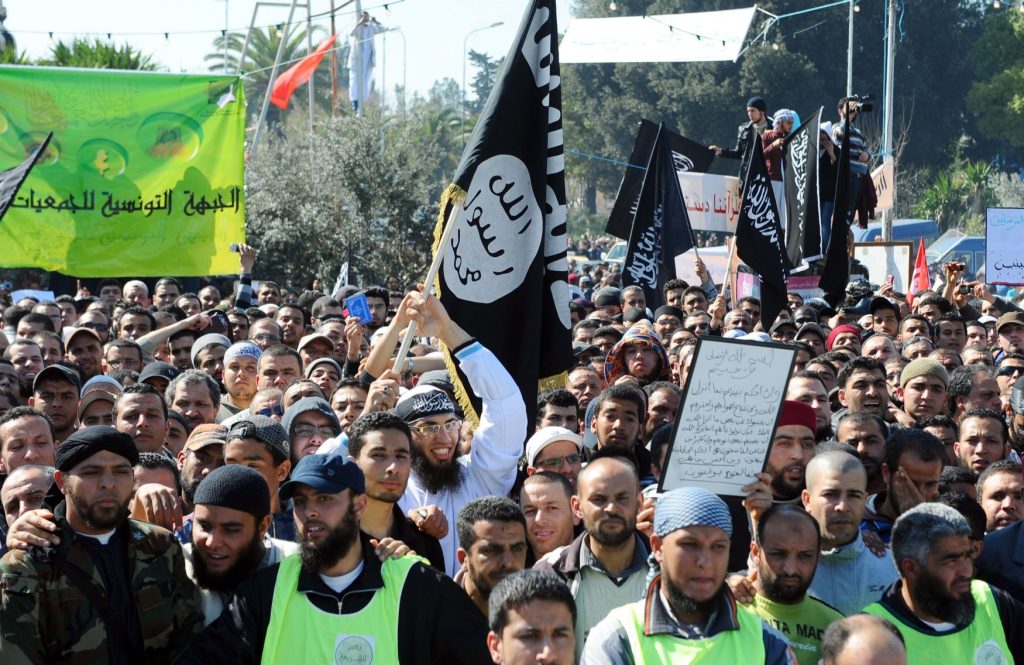
Two months after his release from prison in April2011, pursuant to the amnesty decreedin February 2011, Abou Yadh, the former leader of the Milan cell, organized the founding congress of the “Ansar al-Sharia ” Group in la Soukra, near the city of Tunis, the country’s capital city. The group was composed of most of his now amnestied companions, all of whom were members ofthe Milan Cell. Mohamed Aouadi, Sami Essid, Mehdi Kamoun, Nour Eddine Selmi, and Adel Ben Soltane or Adel Hamdi (the latterindeed has changed his family name after the revolution) were among them.
During this Soukra congress, Abou Yadh declared that Tunisia has now become a land of preaching and not of Jihad. In reality, it turned out to be a land of both preaching and jihad.
Tents were anchored to the ground throughout the country, the stated purpose of which was to preach the good word and to carry out charitable actions. These tents were an opportunity for Ansar al-Sharia to replenish their ranks by new members from among
72 Criminal chamber of the Permanent Military Court of Tunis,N°° 16851, dated January 26, 2005.
the sympathizers of the jihadist ideology, (already jihadist fighters returning from conflict or warzones)
At the same time when the charitable caravans criss-cossed Tunisia’s roads, an armed wing (Katibet Ibn Nafaa), acting in secrecy, was formed.
It was Mohamed Aouadi, an influential member of the Milan Cell, who was the instigator of this group. He traveled to Dirna training camp in Libya on August 4, 2012 to meet the members of “Ansar Libya” (who subsequently joined the ranks of Daesh).
The preaching tents and charity caravans were used to recruit young people into the conflictzones in Syria and Libya.
Sami Essid and other companions of his recruited fighters on behalf of the Syrian
“Jebhet Ennosra” as well as on behalf of Libyan armed groups.
Mehdi Kamoun was at the head of three terrorist cells operating in Tunis city, in La Soukra on the outskirts of the capital, and in Gammarth and Bhar Lazrag.
Ansar al-Sharia who had sworn allegiance to Al-Qaeda in the Islamic Maghreb (AQMI) was thenled by Abdelmalek Droukdel. Their feats of arms include:
· Training fighters on the handling of firearms in the Libyan camps
· Smuggling firearms from Libya into Tunisia
· The attack on the US Embassy on September 14, 2012
· Assassinations and assassination plots
During his interrogation, Hichem Ben Rabeh admitted that Mehdi Kamoun was responsible for targeting Tunisianpublic figures, politicians, journalists and trade unionists such as Hassine Abassi, the formersecretary general of the UGTT or Mongi Jouini, a leader of a policeunion.
The ban onAnsar al-Sharia classified as a terrorist organization on August 27, 2013
Most of Ansar al-Sharia’s leaders were arrested. Abu Yadh, as for him, was on the run. Mohamed Aouadi, head of the Ansar al-Sharia armed group, was arrested. Mehdi Kamoun, who was about to flee into Libya, was arrested in Gabes. Moez Fazani was deported from Sudan where he hadtraveled from Niger after fleeing Libya in the aftermath of the American strikes. During his escape from Libya, he was helped by Fathi Massaoudi (a Tunisian psychiatrist, who had lived in Sudan before settling in the UK) whom hehad met in the training camps in Afghanistan. For the Milan Cell, he was a reference just like Abu Qatada, the Palestinian.
Conclusion
The members of the Milan cell were prosecuted before the Italian courts as well as before courts in other European countries. In 2008, after having served their prison sentences in Europe, they were deported to Tunisia where they were put to military trial. Concurrently, the Milan Cell was officially listed as a terrorist organization operating in peace time. The prison sentences handed down in 2000 were sometimes up to 100 years.
Most members of the Milan Cell remained united and in contact with one another. All of them had become experienced in terrorism organization altechniques, which made it possible for them to establish “Ansar al-Sharia”, the first local Qaida cell alongside that of Yemen.
Having been disintegrated, the Milan Cell was reincarnated as Ansar al-Sharia, the organization which was subsequently dissolved as most of its leaders got arrested. However, it is still likely that the group may be reestablished under other names and in line with the new regional and global trends of terrorist organizations.
The members of the Milan Cell were now reunited and grew even stronger thanks to the years spent in prison, which allowed them to get together and create Ansar al-Sharia in the aftermath of the amnesty. Tunisian prisons have been a pillar of the country’s counterterrorism strategy. This strategy is necessary to avoid turning prisons into sites of recruitment and regrouping of terrorists or into a basis for the spread of terrorist ideology in Tunisia.

