



The attack on the home of Lotfi Ben Jeddou, the Minister of the Interior speaks volumes about the organic and structural dysfunctions of the State institutions in the face of terrorism, a core issue at the national, regional and international levels. Underlying the narrative of the tragic events reported here based on the documents, minutes, telegrams, recordings and reports prepared by the various National Security departments, is the profile of a man, the Minister of the Interior, Lotfi Ben Jeddou, a judge well established in Kasserine, his native city located on the Algerian border and notorious for all forms of trafficking. A city that has over the last two decades turned into a stronghold of Tunisian terrorism. The upheaval wrought by the January 14, 2020 Tunisian Revolution propelled Lotfi Ben Jeddou to greater prominence on the political scene, a career promotion that is typical of the personalities close to Nahdha, the Islamist ruling party. Did this party have the intention, as some argued, to appoint him as head of government to take back control of the executive, then run by a government of technocrats, thus offering him a martyr’s halo? This assumption cannot be overlooked in the context of the heavy atmosphere dominated by the political assassinations of 2013. Except that if, as this account of the attack on the home of the Minister of the Interior shows, it ispossible to manipulate with impunityand ad infinitum the scale of command of services as sensitive as those dedicated to fight terrorism, the price to be paid then would grow increasingly higher. If tampering with services as crucial as those dedicated to state security aimed to serve the political ambition of some political parties, the ensuing malfunctioning has clearedthe way, as this story shows, for terrorism, a new player in town, to achieve remarkable successes and to establish itself as an inescapable fact in today’s Tunisia.
On the night of May 27, 2014, the home of Lotfi Ben Jeddou, then Minister of the Interior, was attacked by terrorists. The attack left four law enforcement officers on shift that night dead and two seriously injured.
On September 30, 2016, the court handed down a ruling whereby 24 defendants were sentenced to the death penalty. In addition to this ruling, cumulative prison sentences of up to thirty-six years were pronounced in addition to five years of administrative surveillance. Twelve other defendants were sentenced to prison terms ranging from three to ten years, and seven others were acquitted.
This attack raised so many questions that have remained unanswered to date. Were the guards securing the Minister’s home taken by surprise by the squad of twenty-five terrorists who committed the attack? Did the Ministry of the Interior receive intelligence about the attack before it took place? Did the Ministry use all the means available to it to fend off the attack? Why did the Ministry fail to protectits officers? Why hasn’t the justice system been able till today to take cognizance of all the documents and information that the Ministry of the Interior had in its possession?
To answer all these questions, we need to recollect the preparation for the terrorist operation itself and the riposte by the Ministry of the Interior.
The Ministry knew about the attack seven months in advance
Because his home was located in Kasserine, in the interior of the country, the Minister of the Interior travelled there only occasionally. On 23 October2012, his brother, who lived nearby and who watched over the house, informed him that someone attempted to break into the premises. Having been alerted of the attempt, the guards inspected the house and its vicinity, without there being anything to report9. Nonetheless, the Ministry’s central department decided to tighten up the security measures already in place.
Seven months prior to the attack, a telegram dated October 28, 201310 was sent by Col. Zouheir Seddik, Head of the MoI’s Command Center, indicating that specific intelligence was gathered by the Intelligence Services regarding a potential attack on the Minister’s home and requesting that an effective plan be promptly set up to riposte to any such attack. To this end, Col. Seddik required that the police squad be duly equipped with weapons,means of communication, night vision devices and bullet-proof vests11.The telegram stressed the necessity to consider the best scenarios to ensure the Minister’s home and its vicinity are properly protected. The telegram goes on to state that these measures must engage all the units entrusted with keeping order12 through unannounced checks aimed to ensure that the guards were operational, obeyed orders and were ready to address deficiencies, if any13. The telegram requesteda detailed reporton the measures taken to be submitted every day before 9:00 p.m. to the Ministry’s Central Command Center.
9 Urgent notification telegram, No. 1291/C of October 23, 2012, drafted by Mohsen Haouachi, the Chief of Police at that time
10 This telegram was not transmitted to the courts, although it was mentioned in the minutes.
11 ibid
12 ibid
13 ibid
As this note dated October 28, 2013 clearly shows, the Ministry knew all too well that terrorists would target the Minister’s home. On the same day, at16:00 hours, as soon as the telegram was delivered, the National Police Regional Command convened in Kasserine14, the city where the Minister’s home is located, to deliberate on the sole item on the meeting’s agenda: securing the Minister’s home15. A decision was taken to immediately place 12 police officers under the command of an officer from the Public Order Keeping Unit in Kasserine to watch all the home’s entrances and exits. As regards the night shift, a similar number of officers were placed under the command of a National Police officer. At the same time, an officer from the National Guard was assigned to carry out overnight surveillance from the terrace of the National Guard Building located across Ben Jeddou’s house16.
14 Minutes of the hearing of 28/10/2013. The Chief of the Traffic and Postings Police, as well as the Regional Head of Law Enforcement Forces in Kasserine, the Chief of the National Police of Kasserine, a representative of the Chief of Counter Terrorism Services, the Chief of Special Services of the city of Kasserine.
15 The minutes of the hearing of 28/10/2013 indicate that the agenda was immediately discussed and that the note n°846was mentioned.
16 Usually responsible for the surveillance of the house, the National Guard’s office was located across the street from the premises.

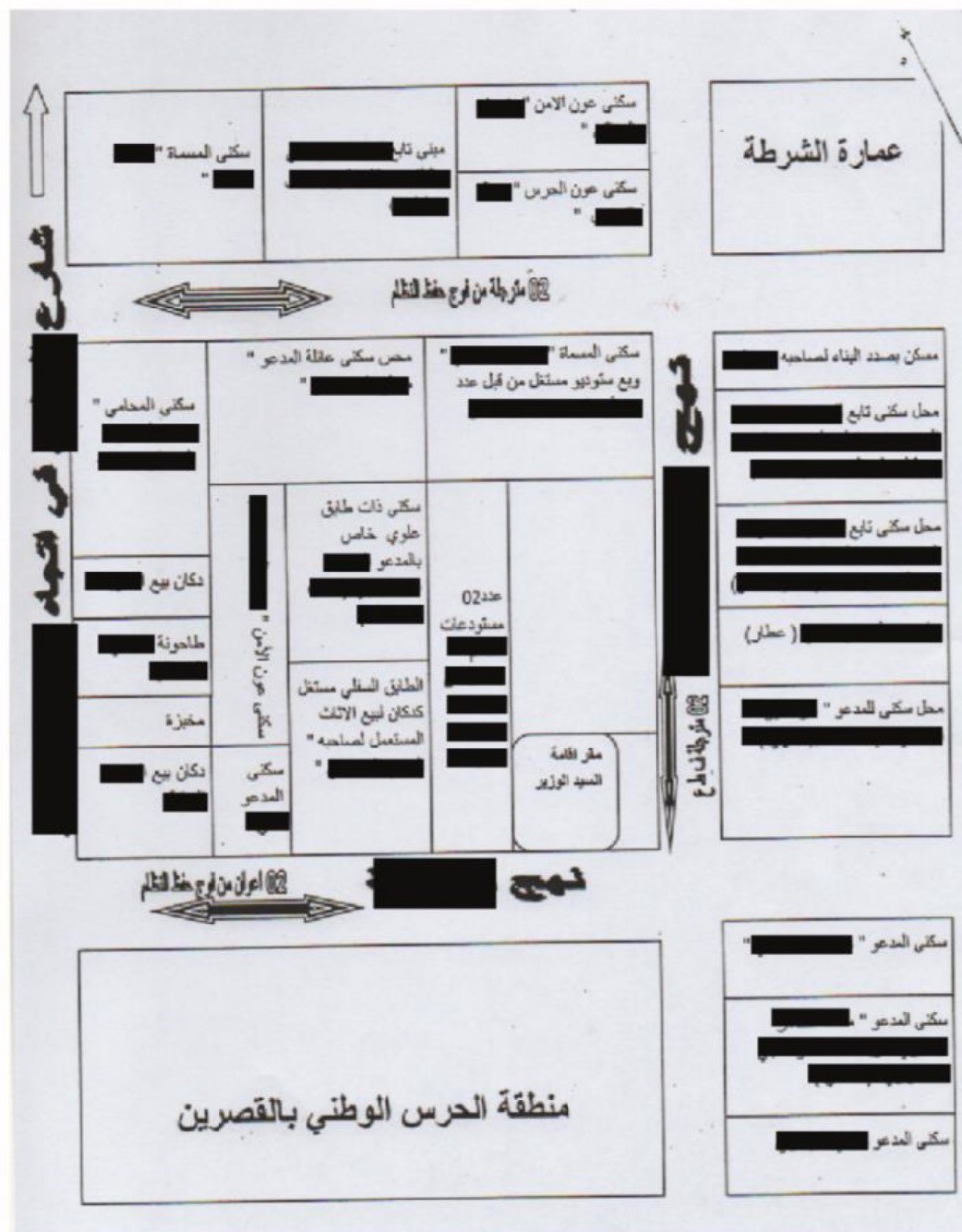
A neighborhood plan is prepared indicating the position of each guard around the Minister’s house.
On the following day, i.e. October29, 2013, the meeting’s minutes were sent to the Central Operations Department at the Ministry of the Interior17. Mean while, the Head of the National Guard confirmed that one ofhis officers was on duty on the roof of the National Guard building located opposite the Minister’s house18.
On November 1st, 2013,the Minister’s brother received threats over the phone. When interrogated, the person who made the phone call said that he had acted under the influence of alcohol. He was referred to the court to answer for this alibi19.
A work meeting chaired by the Director of the National Police in Kasserine took the decision to put the guards on duty at the Minister’s house on high alert, thus ordering them to report all information in their possession and to step up patrols at all times of day and night20.
An unpredictable and risky decision
Suddenly, without warning, at a time when the security forces were exercising maximum vigilance and coordinating their action, and while the intelligence services confirmedthe very serious likelihood of an imminent attack, the state of alert was discontinued despite the heightening terrorist threats as confirmed by intelligence. The state of red alert waslifted and the surveillance measures reduced.
On January 31, 2014, without any justification, the security forces in the region loosened the security measures around the Minister’s house,describing this move as “partial change to the surveillance scheme”21: the number of police officers on guard duty was cut by half; instead of the 12 officers initially deployed around the house, only six officers remained in place during the dayand six over the night. The surveillance carried out from the roof of the National Guard building opposite the Minister’s house was simply cancelled.
17 The immediate sending of the minutes at around 10a.m. shows that the matter was taken very seriously.
18 Missive No.19/ of 29/10/2013 sent by the Chief of the National Guard in the city of Kasserine to the MoI Central Command Center.
19 Missive n°2641/C of November6, 2013 drafted by the Chief of the National Police of the city of Kasserine
20 Minutes of the meeting of 19/12/2013, n°1978/M.K. drafted by the Chief of the National Guard of the city of Kasserine. The meeting was attended by the Head of the Regional Coordination and Monitoring Department, the Head of the Regional Traffic and Posting Department, the Chief of the Law Enforcement Forces of the city of Kasserine, the Chief of the National Police of the city of Kasserine, the Head of the Secretariat Services and the Head of the Operations Department of the city of Kasserine.
21 Minutes of the meeting on the measures for the protection of the home of the Minister of the Interior No. 334/DMK of January 31, 2014. Were present the Chief of the Regional Traffic and Postings Department, the Chief of Law Enforcement Forces in the city of Kasserine, the Chief of the National Police in the city of Kasserine, the Head of the Secretariat Services and the Head of the Operations Department in the city of Kasserine.
A new, scaled-down protection plan was formulated on the occasion of the meeting held onJanuary 31st, 201422 at the very moment when the terrorist threats looming over the city of Kasserine grew more and more serious. The terrorists, who were brought up in the very city of Kasserine, acted with arrogance. They devised an action plan with clear roles assigned to everyone. In fact, the father of Aymen Rtibi received a phone call from his son informing him that he was preparing to commit a suicideattack23. The terrorist MouradGharsalli was not shy to utter threats over the phone against the MoI’sRegional Command Center in the cityKaserine. He threatened and insulted the Minister of the Interior after Kamel Gadhgadhi was declared dead (during a raid by the security forces24 on Raoued, on the northern outskirts of the city of Tunis). The subsequent interrogations
22 See the diagram in the Arabic text
23 Urgent notification telegram n°42/S of 4/2/2014.
24 Urgent notification Telegram No. 45/S dated17/2/2014 in which the terrorist is reported to have said, among other things, that Kamel Gadhgadhi was wrong in not listening to him when he warned him that if he went to the capital he would be arrested. Insults and threats were addressed to Ben Jeddou, the Minister of the Interior
performed at the end of February2014 would reveal that Mourad Gharsalli was the mastermind behind the attack25.
However, the most important red flag in this story came from the confessions made by the terrorist Mourad Rtibi who, on February 14, 2014, i.e. three months before the attack was carried out, declared that he had provided the terrorists who had taken to the mountains with supplies and that he knew all about the police patrols in the region, particularly as concerns the guards performing surveillance at the Minister’s place26. In spite of all these alarming signals, the surveillance plan, in its scaled-down version, remained unaltered.
The intelligence services knew about the terrorists’ deployment plan
The now proliferating information wasbeing quickly reported to the hierarchical superiors, i.e. either the MoI Central Command Department or the National Security Director-General. However, it took one month for an important piece of information to reach the MoI: a secret meeting of the terrorists took place on January11, 2014 to assign tasks. In this meeting (of which the MoI was informed only on February 15, 2014), the terrorists instructed Abdel Kader Rhimi, alias Ouled Zad El Mel, who was wanted by the police, to watch the movements of the security force guarding the Minister’s house and the premises next to the building of the National Guard. Mourad Rtibi, on the other hand, was ordered to monitor the comings and goings of the Minister’s family members both at the house and at “Chichkhan”, the nearby coffee shop owned by the Minister’s brother27.
The Director of Intelligence and Special Services at the MoI had knowledge of information about an imminent attack on the Minister’s house. Likewise,the Director of the National Guard was informed that the terrorist called Sofiane Rtibi was tasked with monitoring the security forces’ patrols in Kasserine, particularly in the vicinity of the Minister’s house, and to report the matter to Sami Rhimi and Jihad M’barki, his fellow terrorists28. Faced with the growing terrorist threat and its deployment plan, and despite the inspection report highlighting the inadequacy of the security measures implemented throughout the city ofKasserine29, no decisionwas taken to strengthen the saidmeasures.
What is more, on April 3, 2014, two months before the attack, the army commanders ordered eleven mechanized infantry units to be withdrawn from the units in
25 Urgent notification telegram No. 145/S dated February 14, 2014. The note adds that the terrorists were watching the “Chichkhan” coffee shop owned by the Minister’s brother and had considered setting off a bomb there.
26 Urgent notification telegram n°60/S of1 5/2/2014 addressed to most law enforcement general departments.
27 Urgent notification telegram n°63/S dated 15/2/2014
28 Missive n°703/SM (Strictly confidential, مطلق سري) sent to the Directorate-General of National Security dated 18/2/2014 and received on the same date under n°1186.
29 Inspection report from the Inspectorate-General of National Security dated 15/3/2014.
charge of protecting the city of Kasserine. These units had in fact been deployed to protect the seats of the Governorate and of the SNCPA Company in the city30.
The information regarding this decision was given at a meeting between the Commander of the armed troops and the Director of the National Guard in Kasserine31. In addition, on May 10, 2014, young inexperienced recruits joined the National Police force of Kasserine. A decision was also taken whereby the National Security Command Center of the region would from then onwards be closed during the night.
In the aftermath of a second inspection mission carried out on April 16, 2014, one month before the attack, by the National Security General Inspectorate, it was noted that the National Security Command Centers at Feriana, Sbeitla and Kasserine were closed at night and that there was no police checkpoint at the cross roads of the cities of Feriana and Thelepte. Moreover, for more than 5 years, none of the law enforcement officers had received training, particularly in the use of shoulder-fired weapons. Finally, the inspection report indicated that the police force in charge of security at the home of the Minister of the Interior did not have enough bulletproof vests32.
A meeting on securing the home of Lotfi Ben Jeddou attended by the Commander of the regional National Security forces, the regional Head of Intelligence and the Chief of the Traffic Police instructed the intelligence units to patrol the location under threat using, among other things, a car fitted with all the necessary devices for rapid intervention. A squad of law enforcement officers along with an intelligence officer were on board33. Clearly, however, at the time of the terrorist attack none of these measures were applied.
Failures all across the board
The report prepared by the Regional National Police Command Center in the city of Kasserine pointed out failures at all levels following the events that happened over the night of May 27, 2014. Indeed, the report states that:
“At around 11:45 pm, several shots were fired and heard at the neighborhood called “Ezzouhour”. However, we received only one phone call from a police officer stationed in front of the home of the Minister of the Interior. As we could no longer reach the squad of guards by phone, we sent reinforcements while heavy fire intensified. Around midnight, we learned that four of our law enforcement colleagues were killed and another was injured34”.
30 Missive from the Director-Regional of National Security of the city of Kasserine n°1279/MK, dated 3/4/2014
31 Telegram n°1406 from the Director of National Security dated 22/4/2014
32 Inspection report n°1226/TH of the Inspectorate-General of National Security dated 22/4/2014.
33 Minutes of meeting n°897/A dated May 6, 2014.
34 Handwritten bulletin from the Command Center of the Kasserine police unit signed by the Head of the Operations Department, National Security Printing Office n°145
In a show of strength, while the fire works and the gunfire illuminated the sky, the roaring of the Salafiste terrorists erupting with the “Allah Akbar” shouts of victory filled the air. They all were followers of Khatib el Idrissi, a blind preacher from Ben Aoun, a locality near Kasserine, whose son, Osama Khatib, was present that evening on the very premises where the shots were fired. Unimpeded and with complete impunity, the terrorists, already notorious for their feat of arms during the Soliman’s episode, displayed their might with fireworks and gunfire.
When Kasserine’s Law Enforcement Commander recounts the attack, he does not fail to mention that he fired fourteen shots in the air “to inform of the arrival of reinforcements”35.Given the fact that all security measures had been disregarded, one might reasonably wonder whether the shotswere not intended to warn the terrorists that reinforcements were on their way, thus giving them an opportunity to escape.
Infact, the guards at the Minister’s home received no reinforcements. The Regional Director whose statements have not been transmitted to the courts said: “I have requested reinforcement from the Commander of the regional law enforcement forces. But I did not receive any until the attack was over. I also contacted the Commander of the armed forces at the Kasserine barracks, informed him of the attack and requested reinforcements. He did not send me any, nor did he come himself. I also phoned the Director of the National Guard in Kasserine, but he did not show upuntil around four o’clock in the morning”36. In actual fact,the terrorist attack began shortly before midnight and lasted for about 20 minutes.
35 Urgent notification telegram No. 46/5 of May 28, 2014 summarizing the facts and signed by the Commander of the Law Enforcement Forces of the city of Kasserine
36 See previous note
Oddly enough, what also emerges from the statements of the Commander of the Kasserine police force in his account of the terrorist attack is that the home of the Minister of the Interior was not targeted at all by the attack. In fact, the numerous bullet marks reported were aimed rather at a depot located near the home of Lotfi Ben Jeddou, the rear area of the guard of said home, and the main entrance of the National Guard premises opposite the home of the Minister. Bullet marks were also found on the walls of the neighboring houses as well as on two cars parked on the premises. Other evidence reported in the telegram sent by the Commanderof the Kasserine law enforcement forces37 corroborates the fact that the home of the Minister of the Interior was not actually targeted by the shooting. Indeed, there was no trace whatsoever of any attempt to break into the premises.
Furthermore, the reinforcement consisting of two cars with (law enforcement) officers from the city of Kasserine and traffic police officers on board came under fire at both the level crossing and the crossroads of the Ezzouhour neighborhood. They retreated “to take cover in one of the neighboring streets38”. This move was inexplicable on the part of a squad sent as reinforcement against a terrorist attack.
A strategy to avoid confronting terrorists
The fact that confronting terrorists was avoided can also be inferred from the statements of the Commander of the law enforcement forces in Kasserine. Indeed, He reports having walked with five officerson foot, a tactic that, according to him, would make it difficult for terrorists to spot the law enforcement vehicles39. This changein tactics allowed the terrorists to attack the young guards of the home of the Minister of the Interior, and to put on a show of strength in the Ezzouhour neighborhood before they escaped. This Commander, who claimed to have fired shots to announce that reinforcement was on its way, adds, without fear of contradicting himself, that he chose40 to walk instead of driving to avoid being spotted. He added that he had met Ch. Kh. a police colonel incharge of guarding the house, who told him that he had gone to the bathroom at the National Guard building, heard the shots and escaped the combat zone because he had left his Steyr rifle with one of his fellow officers41. As for the Head of the National Police unit in Kasserine, he simply said that he did not have an official car at his disposal that night. He added that he could not get to the scene of the attack in time when the assault was reported to him by the National Securit yCommand Center and that there was no car specifically dedicated for use in case of terrorist attacks42.
37 Previously cited
38 Instruction minutes of the Inspectorate-General of National Security n°535/1 of 29/5/2014 39 Investigation report of the Inspectorate-General of National Security n°535/ 5 of 30/5/2014 40 See previous note
41 See previous note
42 Investigation report of the Inspectorate-General of National Security n°535/ 7 of 30/5/2014
As for the National Guard Director in Kasserine, he declared having “heard no shots that night. He was sleeping deeply, exhausted after a hectic day of work”43.
That night, all attempts to reach Imed Ghodhbani, the National Security Director- General were in vain. The National Security Office in Carthage, the Central Command Center and the Intervention Brigade in charge of guarding his home went to his place to advise of the Central Command Center’s attempts to reach him44. The time thus wasted at a crucial moment was so valuable.
The target of the attack: an empty house
During the terrorist attack, there was no indication whats oever that the law enforcement officers in place were interested in or concerned about the fate of the minister’sfamily who usually lived in the house. No information was available regarding them. Later, we learned that the Minister of the Interior, who only occasionally visited the house, had phoned his brother, who picked up the phone45 only an hour after the attack began. It was only then that the Minister of the Interior took the decision to impart the information that his brother was not answering his calls.
After the attack was over, no law enforcement officers entered the home of the Minister of the Interior, who, in turn, did not contact any of thefamily members. The interviews with law enforcement officers after the attack showed no indication that the minister’s family was in the house. During the demonstrations organized by the citizens of Kasserine immediately after the attack, no members of the family of the minister showed up.
At 11: 56 pm, when the Minister ofthe Interior learned that there were shots fired in Kasserine near his home, he only asked that the police be made aware of the danger46. It is therefore clear that the Minister knew all too well that his family was safe and that they were not on the premises of the attack on that evening.
At thirty-two minutes past midnight, the news came that the minister’s family was safe47.
Infact, the Minister’s entire family was under close police protection. His daughter’s elementary school was undersurveillance48 and instructions were given in
43 Investigation report of the Inspectorate-General of National Securityn°535/ 4 of 29/5/2014
44 Recording of calls bythe Central OperationsDepartment.
45 Recording of calls made on the night of the attack by the CentralOperations Department in relation to the attack in the city of Kasserine. Typed and handwritten document submittedto the Directorate of the Inspectorate-General of National Security.
46 See previous note
47 See previous note
48 Investigation report n°615/S issued bythe Investigation Unit of the city of Kasserine dated March 11, 2014.
writing to ensure the protection of all the Minister’s family members49. This surveillance taskwas assigned to the InterventionBrigade Directorate-General50.
In fact, the family was not at homethat evening. The two officers who suffered injuries during the attack did not report any such presence, nor did they report any close protection measures during that night.
Two contradictory investigating reports
The malfunctions, the multiplefailures, the contradictions between the departments and the officers, and the ordersand counter-orders noted all across the securityand public order services in charge of the fight against terrorism, will be reflected in the reports produced following the attack on the home of the Minister of the Interior Lotfi Ben Jeddou. As a result, two reports were prepared.
The original report was finalized on June 9, 2019. In actual fact, there were two reports produced on the same date, but with different conclusions51.
The original report brings out the multiple failures of the security forces: the inadequate human and logistical resources allocated to the task; the fact that, at the exception of two officers, all other officers in charge of guarding the home of the Minister had received no training on how to protect public figures and buildings and had just been enrolled in the army; the fact that the meeting of January 31, 2014, during which the decision was taken to strengthen the surveillance of the home of the Minister was attended by neither the Head of the Intelligence Services nor by the Head of the Special Security Services in Kasserine.
In fact, as at January 8, 2014, at a time when public order in Kasserine was underthreat of disruption, the surveillance of the Minister’s home was not reinforced. Instead, it wasreduced by half. Several police premises were burned down on that day, without the Ministry of the Interior paying heed to the seriousness of the situation. The various central directorates of security, public order, special services, and intervention brigades did not act with due diligence to protect the homeof the Minister of the Interior in the face of the looming threats. Finally, the lack of coordination with the various regional law enforcement agencies was a fact in a place where the mountains had been used by terrorists as a hide out since 2011.
The report concludes that these multiple failures should lead to administrative measures and to criminal prosecution against law enforcement officials.
49 Report of the Directorate-General of Public Order n°267/M.D dated 13/3/2014.
50 Missiveissued by the Directorate-General of Public Order n°267/MD (strictly confidential) and intended for the Director of Intervention Brigades.
51 Substantial modifications are made to the first report, which is not submitted to the investigating judge.
The report goes on to recommend inits conclusions that, on the one hand, the National Unit for Investigating Terrorist Crimes deepensits investigations, especially with the first police colonel (CH.KH) and the citizen called (M.CH.A.) as well as with a friend of the latter’s, because of serious doubts about the potential links that they may have with the terrorist groups that carried out the attack, and, on the other hand, that the report should be forwarded to the Public Prosecutor’s Office in order to carry out the necessary investigations regarding the serious failures in the fulfillment of professional duties and the breaches noted inrespect of law enforcement.
The amended report, which was signed by Seif Eddine Ben Abdellatif, the National Security Inspector General, with draws there commendation whereby further investigation and the transfer of the case to the Public Prosecutor’s Office were apriority. Rather, the report recommends that both the Head and the Director of the National Security of the city of Kasserine (on duty at the time of the attack), should appear before the National Police Council of Honor. In fact, they actually appeared before the Councilunder this recommendation, without any of them having been suspended from his work, with the implication that they would keep their jobs in any case and that they would not be subject to anyheavy sanctions52.
In the morning of May 28, 2014, in the aftermath of the attack, the only decisions taken were to move the Head of the National Police Unit of the city of Kasserine to a new postingat the Training Central Department as well as move the Head of the National Security of the city of Kasserine to the Judicial Police Department53. Impunity for failure to respond to a planned terrorist attack was the only response given.
Other questions have remained unanswered: Is this the way security protocols are conceived to face up to terrorist attacks, which are announced and foreseeable? Why haven’t law enforcement officials testified before the courts? And why have all the elements in the possession of the Ministry of the Interior been concealed from the families of the victims, the justice system and public opinion?
On the night of May 27, 2014, the terrorists inflicted death and injury without facing any resistance, withouta single shot being fired at them and without them attempting to break into the home of the Minister of the Interior, the declared target of the attack. They celebrated their victory with a show of strength not far from the scene of the terrorist operation, without any of the law enforcement officers lifting a finger. The blood of the officers’ fellow colleagues that has been spilled is stillspurting out and the blood stains will not soon fade away.
52 Investigation report n°23/SJ of 9/6/2014 presented by Seif Eddine Ben Abdallah
53 Note n°828 of 28/5/2014 signed by the Minister of the Interior, Lotfi Ben Jeddou

