



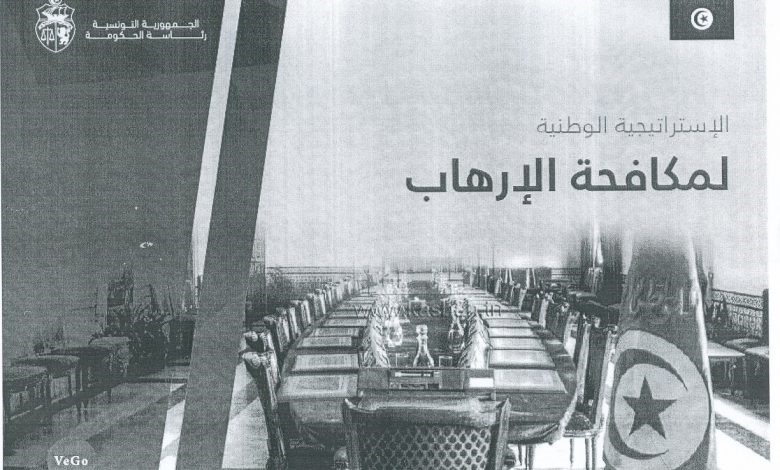
The first years following the revolution witnessed an unprecedented spread of terrorism in Tunisia. Indeed,terrorism has demonstrated an exceptional capacity for resilience, adaptation and evolution, getting its hands on several spaces: places of worship, smuggling, crime, social exclusion and the online world73. In consequence, in 2015 the Presidency of the Government set up a working group to try to understand and counter the phenomenon.
In this first issue of the Review of Studies on Terrorism, we present this unpublished document, dated January 2015.The report was prepared by a working group chaired by a Tunisian expert residing in the French capital based on various types of data that were made available to the group. Of crucial importance, the report displays neither the names nor the qualifications of the authorsof the document. Unpublished, it has been presented neither to the public, nor to researchers, or to the departments and institutions in charge of the fight against terrorism. It would seem indeed that the report was lost somewhere in La Kasbah74.
The report, titled “Holding back terrorism and to drying up its sources. Building capacities to prevent, counter and contain terrorist operations”, is organized into two parts: Diagnosis and Objectives, Principles and Action plans followed by a summary of the entire report.
In the present study, we will use the same two-part plan as in the report.
73 National Counter-Terrorism Strategy, report commissioned by the Presidency of the Government, January2015, 150 pages, unpublished.
74 To date, none of the successive heads of government has talked about the report or even mentioned the existence of such document.
I. The phenomenon of terrorism: a diagnosis
The part dedicated to the diagnosis of the phenomenon of terrorism consists of 58pages divided into four paragraphs.
1. Overview of the terrorist phenomenon in Tunisia
The report lays out four main characteristics of terrorism, which it describes as a generally complex phenomenon: complicatedness, inflexibility, the ability to evolve, and constancy.
The report notes the significant evolution of terrorism since the revolution. Its resilience could be accounted for by internal and external factors. Domestically, terrorism can draw upon a human reservoir of individuals returning from conflict zones. Internationally, the close ties forged between the various terrorist groups, combined with the unstable political situation75 in the region, has helped terrorism to thrive. The ability of terrorism to evolve both tactically and strategically is coupled with a perfect mastery of the technology necessary to carry out terrorist operations.
The report points out that far from just being a domestic phenomenon, terrorism has international ramifications. Indeed, terrorist groups have a global project, that of reinstating the Caliphate76. Any national counter-terrorism strategy must take on global dimensions, taking action in the fields of education, culture, politics and social affairs in cooperation with the other countries struggling with the same phenomenon.
The report reviews the history of all terrorist acts committed by Tunisians before the revolution, including the assassination of Shah Massaoudin Afghanistan, the attack on the border crossing at Sondes in the southern governorate of Tozeur in 1995, the assault on the National Guard in Sarri in May 2000, to the suicide bombing at the Ghriba synagogue in Jerba in 2000, committed by the terrorist Nizar Naouar on the orders of Al Qaeda upon the discovery of the Milan terrorist group in 2007. The report also outlines the history of the various terrorist attacks since the revolution.
· The geopolitics of terrorism
Tunisian terrorists have been trained in training camps in the region, in Mali and Libya, a country that has become a true “guesthouse” for terrorists from around the world. Many Tunisians have also been trained inconflict zones, in Syria and Iraq. The return of terrorists from these areas, including Libya, is a matter of concern, not only in Tunisia, but around the world. In echo to these concerns, the UN Security Council adopted Resolution n°. 2178 dated September 24, 2014.
75 Report mentioned above
76 Report mentioned above
Terrorist groups, which have proliferated in the Sahel region, in Mali as well as in Libya, help and support one another, a worrisome factor that strengthens terrorists and allows them to continue operating.
· Dangers and challenges
The dangers arising from terrorism are many: the dismantling of state structures, the gradual neutralization of civil society components and the strain put on the law enforcement system. Another danger consists in the return of jihadists from the conflict zonesafter they have become experts in assassinations, the manufacture of explosives, encryption, concealment, etc.
The report sheds light on another danger, namely the stranglehold on the religious space. In fact, rigorous religious practices and vocabulary, such as “jihad” or “taghout” have come into use. On another hand, stronger link shave seen the light of day between the religious space and crime and smuggling in particular. The danger also lies in the closer ties with Algerian terrorist groups, such asAQMI77, and the presence of experienced members of this latter group among the terrorists operating in Tunisia. What is more, members of AQMI have been at the head of some of these groups and it is very likely that the first training camps discovered after the revolution (Jbel Senk camp in Feriana, where Anis Jelassi was killed, and Souk El Jemma, where officer Ammar El Felhi from the anti- terrorist unit of the National Guard lost his leg) were led by them.
The closeness of terrorist groups to the population78 was made possible thanks to the preaching tents or the charities that organized caravans to provide care and food to the needy. The tents and caravans were also an opportunity to massively recruit new members into the terrorist organizations.
77 Above-mentioned report, p.48
78 Partly working-class neighborhoods and disadvantaged areas, p.49 of the report
The invasion of the Internet and of social networks under the cover of anonymity helped terrorist groups to broaden their networks and to ensurewide dissemination of their terrorist ideology.
· operational dangers
Among the most important objectives pursued by terrorists are obstructing the democratic process, wreaking havoc by attacking politicians, journalists and artists, targeting the Jewish community, killing tourists, attempting to control working-class neighborhoods, and attacking law enforcement officers and the poorly equipped and understaffed police barracks.
To this we should add other factors, such as the weakness of the intelligence services, inadequate training, the fragmentation of the law enforcement system, entrusting the army with non-essential tasks, and finally, the serious lack of cooperation with the prison administration.
II. The National Strategy
· Objectives
The National Counter-Terrorism Strategy aims to dry up the sources of terrorism and contain the phenomenon, address the internaland external factors behind it, as described above. To this end, it is necessary to strengthen the capacities of the State to fight terrorism.
· Principles
Turn the fight against terrorism into a national endeavor common to all political families as well as engage the international community in this fight.
· Action plans
Sever the relationships between terrorism and its sources, be they religious, geopolitical or social. Create an effective, coordinated and lawful security organization. This has been achieved through the establishment of the Anti-terrorism Security Huband the National Counter-Terrorism Committee.
In conclusion, this major report that sheds light on what it takes to fight terrorism has undoubtedly been the object of political negotiations that led to this report being discarded. However, this document should be published and presented by its authors to feed into the public debate.

